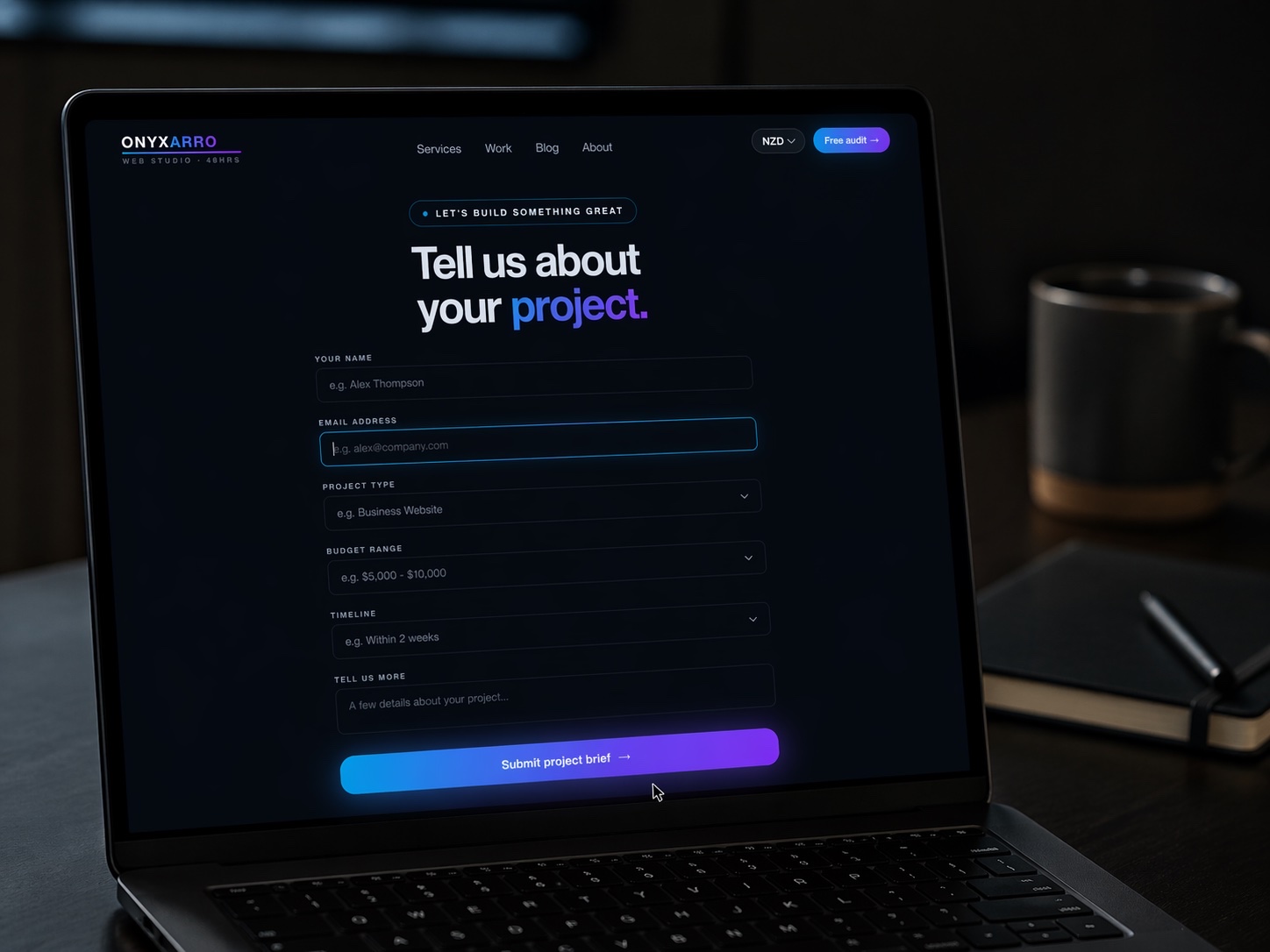
Quick answer: The most useful questions to ask a web designer before hiring cover six things: what the price includes, who owns the finished site, how they handle conversion, how long the build takes, what happens after launch, and whether they can show real work. Get clear answers on those before you pay a deposit, and most of the horror stories never happen.
Hiring a web designer is one of those decisions where the risk is invisible until it is too late. The quote looks fine. The portfolio looks nice. Then three weeks in you find out the price did not include copywriting, you do not actually own the hosting, and the homepage has no clear reason for a visitor to enquire.
None of that is bad luck. It is almost always the result of questions that were never asked. A good web designer will welcome the questions, because it means you are a serious client who knows what they want. A designer who gets defensive when you ask about ownership or pricing is telling you something useful for free.
This guide gives you the exact questions to ask, why each one matters, and what a good answer sounds like. Steal the whole list.
Why the questions to ask a web designer before hiring matter more than the quote
Most website disappointments trace back to a mismatch in expectations, not a lack of skill. You thought you were buying a lead-generating machine. The designer thought they were building a five-page brochure. Both of you were technically right, because nobody said the words out loud.
The questions below do one job. They pull the assumptions out of everyone's head and put them on the table before money is involved. That is the cheapest insurance you will ever buy on a web project.
Ask them by email, in a call, or over coffee. It does not matter how. What matters is that you get answers you can point back to later if things drift. A vague verbal promise is worth exactly what you paid for it.
Questions about scope and what is included
Scope is where most budgets quietly explode. Two quotes for the same number can include wildly different things. One might include copywriting, images, and a contact form that actually delivers to your inbox. The other might be a design shell you have to fill in yourself.
Scope questions to ask
- What exactly is included in this price, page by page?
- Does the price include copywriting, or do I write the words?
- Are images and photography included, or do I supply them?
- Is the site mobile-first, and will you test it on real phones?
- How many revision rounds are included before extra charges start?
- What is specifically not included that I might assume is?
That last question is the sharpest one on the list. Asking what is not included forces the designer to name the gaps out loud. If they say everything is included, ask them to put that in writing too. More pages do not automatically mean a better website. Sometimes it just means more places for the visitor to get lost.
Questions about pricing and payment
Price is not the enemy. Unclear price is. A fixed quote you understand beats a cheap hourly rate that quietly climbs every week. When you are hiring a web designer, you want to know the ceiling, not just the starting point.
Here is a rough sense of what business owners pay, so you can judge whether a quote is sane.
| Type of build | Typical range (NZD) | What you usually get |
|---|---|---|
| Basic freelancer site | 1,500 to 3,500 | A few template-based pages, light on strategy |
| Small business site | 3,000 to 8,000 | Custom design, real copy, conversion focus |
| Larger custom build | 8,000 to 20,000+ | Ecommerce, CMS, deeper content, integrations |
These are ranges, not promises. Prices move with scope, location, and how much strategy sits behind the build. For a fuller breakdown, our guide on how much a website costs walks through what actually moves the number.
Pricing questions to ask
- Is this a fixed price or an estimate that can change?
- What would trigger an extra charge later?
- What is the deposit, and what is the payment schedule?
- Are there ongoing costs like hosting, domain, or a care plan?
- What happens to the price if I add a page halfway through?
A designer asking for the full amount upfront, with no clear scope, is not a bargain. It is a risk with an invoice attached.
Questions about conversion, not just looks
This is the question set most people forget, and it is the one that decides whether the website ever pays for itself. A pretty website can still be a weak salesperson. If nobody enquires, the colour palette did not save you.
A website that looks great but generates zero enquiries is an expensive business card. The point is not to impress designers. The point is to make it easy for a real customer to take the next step.
Conversion questions to ask
- How do you decide what goes at the top of the homepage?
- What is the single main action you want visitors to take?
- How will you make it easy for someone to enquire or book?
- How do you handle trust signals like reviews and guarantees?
- How would you measure whether the site is actually working?
Listen for whether the designer talks about the visitor's decision, or only about the design. If every answer is about aesthetics, you are getting a portfolio piece, not a sales asset. Our breakdown of what makes a website convert covers the patterns a good designer should already know by heart.
Questions about ownership and access
This is the boring question that saves people the most pain. If you do not own your domain, hosting, and files, you do not really own your website. You are renting it, and the landlord holds the keys.
Ownership questions to ask
- Will the domain be registered in my name and my account?
- Do I get full access to the hosting and the CMS?
- Do I receive the final files if I ever leave?
- Am I locked into a specific platform to keep the site running?
- What happens to my site if we stop working together?
Some cheaper builds keep you on a platform you cannot leave without starting over. That is fine if you know it going in. It is a nasty surprise if you find out two years later when you want to switch. Get the answers in writing before the deposit, not after.
Questions about timeline and process
A timeline is only as honest as the process behind it. Ask how the build actually runs, not just when it finishes. The most common reason a website runs late is not the designer. It is content that never arrives from the client side.
Timeline questions to ask
- How long from deposit to launch, realistically?
- What do you need from me, and by when?
- What is the most likely thing to slow this down?
- How and how often will you keep me updated?
- What happens if I go quiet for a week during the build?
A clear process is a sign of a designer who has done this many times. If the answer to how long it takes is a shrug, expect a build that drifts. For a realistic view of timelines, see our guide on how long a website should take to build.
Questions about SEO and being found
A beautiful site nobody can find is a very quiet kind of failure. SEO starts with how the site is built, long before you write a single blog post. Clean structure, fast loading, and proper headings are not extras. They are the foundation.
You do not need the designer to promise rankings. Nobody honest can. You do need them to build a site that a search engine can read easily. Google's own SEO starter guide lays out the basics any competent build should already respect, and web.dev covers the loading speed signals that affect both users and rankings.
SEO questions to ask
- Is basic on-page SEO included in the build?
- Will the site load fast on mobile?
- Are page titles, headings, and meta descriptions handled properly?
- Will the site be indexable, with a sitemap submitted?
- Do you build in a way that supports content and ranking later?
If SEO is framed as a separate paid add-on for things that should be standard, that tells you how the site will be built. Good structure should come with the build, not a surprise line item.
Questions about support after launch
Launch day is the start, not the finish. Websites need small updates, occasional fixes, and someone to call when something breaks. Find out what happens after the confetti settles.
Support questions to ask
- What support is included after launch, and for how long?
- What does it cost to make changes later?
- Is there a care or maintenance plan available?
- How quickly do you respond if something breaks?
- Can I make simple edits myself, or does everything go through you?
Some owners want to edit their own text. Others never want to touch it. Neither is wrong. Just make sure the setup matches how you actually work, so you are not stuck emailing for a one-word change six months from now.
Questions that reveal real skill
Anyone can show you their nicest three projects. The better test is how a designer thinks. These questions surface craft that a polished portfolio can hide.
Show me a site you fixed
Ask for a project where they improved a struggling site. It reveals whether they understand why sites fail, not just how to make them look nice.
What would you not build?
A designer who will talk you out of an unnecessary feature is worth keeping. It means they care about your outcome more than your invoice.
Explain your homepage choices
Point at a homepage in their portfolio and ask why they put things where they did. Good answers are about the visitor. Weak answers are about taste.
How do you know it worked?
Ask how they measure success after launch. Enquiries, calls, and bookings are real. Compliments on the design are pleasant but do not pay the bills.
You are not trying to catch anyone out. You are checking that they think about your business, not just the pixels. For a wider view on vetting, our guide on how to choose a website designer goes deeper on this.
Red flags to listen for
Some answers should make you pause. None of these are automatic dealbreakers, but a cluster of them usually means the project will be harder than it needs to be.
- A quote with no written scope or line items.
- Full payment demanded upfront with no milestones.
- No questions asked about your business or your goals.
- Every answer is about design and none about enquiries.
- Ownership of domain, hosting, or files is dodged or unclear.
- Big promises about rankings or traffic with a guarantee attached.
- Vague timelines and no clear process.
A confident designer answers these questions plainly. Defensiveness, salesy deflection, or a rushed brush-off is the tell. You are about to trust this person with the front door of your business. It is fair to expect straight answers.
How Onyxarro answers these questions
We wrote this list partly because we get asked these questions ourselves, and we would rather clients ask more of them. A good brief with sharp questions makes for a better website. Here is how the answers look on our side.
Onyxarro at a glance
- Fixed pricing: Launch starts at NZ$5,000 NZD for up to 5 pages. Growth is NZ$8,000 NZD for up to 10 pages. Studio starts at NZ$13,000 NZD for custom scope.
- Conversion first: Every build is designed around one clear action, not just how it looks.
- You own it: Your domain, your hosting, your files. No hostage situations.
- Fast preview: A homepage redesign preview in 48 hours, so you see the direction before committing further.
- Built for search: Clean structure and on-page SEO come standard, not as an upsell.
The honest note: we are a young studio, so we lead with craft and clear scope rather than a wall of case studies. If you want a reference point before you brief anyone, get a free website audit and we will show you where your current site is leaking enquiries. If you would rather compare packages, take a look at our services and pricing. Our concept demos are exactly that, concept builds, not client sites, so you can see the standard without us pretending they are live case studies.
The bottom line
The questions to ask a web designer before hiring are not about catching people out. They are about matching expectations before money moves, so the website you imagined is the website you get.
Ask about scope, price, conversion, ownership, timeline, SEO, and support. Then ask to see real thinking, not just a highlight reel. A good designer will answer all of it without flinching. That confidence, in plain English, is the best signal you will get that you are hiring the right person.
If you want a clear read on where your current site stands before you brief anyone, start with a free audit. It is the fastest way to turn a vague feeling that something is off into a specific list of fixes.