Quick answer: The honest answer to how much does a landing page cost in 2026 is that most New Zealand businesses pay between NZD $500 and $1,500 for a template page set up by a freelancer, and NZD $2,500 to $6,000 for a custom, conversion-focused page with strategy, copy, tracking, and mobile testing. Agency builds with ongoing A/B testing often start around NZD $8,000, usually with a monthly fee on top.
Landing page quotes are strange. Ask three providers and you'll get three numbers that look like they came from three different economies. One says $400. One says $3,500. One wants a discovery call before they'll say anything at all.
Usually they're all quoting for different things. The $400 page is a template with your logo dropped in. The $3,500 page might include a proper brief, written copy, conversion tracking, and a form that actually lands in your inbox. Same word, very different job.
This guide is for small business owners about to spend money on ads, a campaign, or a launch, who want to know what a fair price looks like before signing anything. You'll get typical NZD ranges, what moves the number, the costs that turn up later, and a simple way to work out how much is worth spending. No mystery boxes.
How much does a landing page cost in 2026? The typical ranges
This table lays the market out by how most people actually buy. The numbers are typical New Zealand ranges for a single landing page, not quotes. They move with scope, location, and how much thinking sits behind the build.
| Option | Typical upfront (NZD) | Ongoing | What you usually get |
|---|---|---|---|
| DIY page builder | Your time | Monthly builder subscription | A template, your own words, a basic form |
| Template set up by a freelancer | 500 to 1,500 | Builder or hosting fee | Branded template, light edits, little strategy |
| Custom freelancer page | 1,500 to 4,000 | Hosting, paid edits | Custom layout, some copy help, basic tracking |
| Conversion-focused studio | 2,500 to 6,000 | Hosting, optional care plan | Brief, copy, design, build, tracking, mobile QA |
| Agency with a testing program | 8,000 to 20,000+ | Often a monthly retainer | Research, multiple variants, A/B tests, reporting |
Most small businesses should be looking at the middle of that table. Below it, you're mostly paying for setup. Above it, you're paying for an ongoing testing process that only makes sense once you have enough traffic to test with. A page getting 300 visitors a month needs a clear offer and a working form. It doesn't need a five-figure optimisation program.
What you're actually paying for
A landing page has one job: get a specific visitor to take a specific action. Every dollar in the quote should serve that job. If a line item doesn't, ask why it's there.
A properly scoped landing page usually covers six pieces of work:
- Strategy. Who's arriving, where from, what they searched or clicked, and the single action you want them to take. This is the cheapest part to do and the most expensive part to skip.
- Copy. The headline, the offer, the objections, the proof, the call to action. Most landing pages live or die here. Our guide to website copywriting cost covers what good words typically cost on their own.
- Design. Layout, visual hierarchy, and a mobile version designed on purpose rather than squashed into place.
- Build. Fast loading, working forms, and connections to your inbox, CRM, or booking tool.
- Tracking. Conversion events set up so you can see which ads produce enquiries, not just clicks.
- Testing and launch. Real phones, real form submissions, real speed checks before a cent of ad money goes near it.
Drop any one of these and the page still exists. It just works less well, and you tend to find out after the ad budget has already gone.
Five ways to buy a landing page (and who each one suits)
None of these options are wrong in general. The trick is matching the option to how much is riding on the page.
Cheapest cash, most of your time
Good for testing an idea, collecting event signups, or running a small campaign. You'll write the copy and make every call yourself, which is fine if you know what converts and painful if you don't.
Quick and tidy, light on thinking
Someone sets up a proven template with your branding. It'll look professional. Whether it persuades anyone depends on the words you hand over.
Real design, variable strategy
A good freelancer can produce excellent work. Quality varies a lot, so ask who writes the copy and who sets up tracking before you compare prices.
The full job in one scope
Brief, copy, design, build, and tracking handled together. This is usually the best fit when the page is about to receive paid traffic and needs to earn its keep.
Testing as an ongoing service
Multiple variants, structured experiments, monthly reporting. Worth it with serious traffic and spend. Overkill for most local service businesses.
Most small businesses running paid ads sit between the custom freelancer and the small studio.
What pushes the price up or down
Two similar-looking pages can be priced very differently. The reason is usually on this list.
The main cost drivers
- Who writes the copy, you or the provider
- Custom design versus a modified template
- Page length and number of sections
- Integrations with a CRM, booking system, or payments
- Conversion tracking for Google Ads, Meta, and analytics
- Number of versions, such as one per service or per suburb
- Platform, whether a page builder, your existing site, or a custom build
- Photography, video, or illustrations
- Turnaround time and number of revision rounds
Copy is the biggest swing factor. Writing it yourself is the quickest way to cut a quote. It's also the quickest way to waste an ad budget, if the words don't answer the questions your visitors are actually asking.
Versions are the sneaky one. A plumber who wants separate pages for blocked drains, hot water, and emergency callouts isn't buying one landing page. They're buying three, and each one needs its own headline, proof, and offer.
The hidden costs nobody mentions early enough
The upfront price is only part of the bill. These running costs often appear after everyone has stopped smiling.
| Ongoing item | Typical range (NZD) | Notes |
|---|---|---|
| Landing page builder subscription | Often 50 to 400 per month | Plan limits on traffic or pages can push you up a tier |
| Hosting | 0 to 50 per month | Often free if the page sits on your existing site |
| Domain | Around 25 to 60 per year | Only if you buy a separate domain for the campaign |
| Form, CRM, or email tool | Free to 100+ per month | Free tiers are fine until they aren't |
| Edits after launch | Often 80 to 180 per hour | Price changes, new offers, seasonal tweaks |
| A/B testing tool | Varies widely | Only worth paying for once traffic justifies it |
The subscription line deserves attention. A page that costs $800 to set up on a builder charging $200 a month has cost you $3,200 by the end of year one. That can still be the right call. Just make sure you're comparing totals, not deposits, and the same goes for booking website costs, where monthly software fees add up the same way.
Also ask who owns the page if you stop paying, because on some builders it disappears with the subscription. If hosting costs are new territory, our breakdown of website hosting cost explains the renewal traps in plain English.
When a cheap landing page is the right call
Spending less is often sensible. A cheap page is fine for a short event registration, an early test of whether anyone wants a new service, a giveaway, or a page you're sending to your existing email list who already know and trust you.
A cheap landing page is fine when the stakes are cheap. It gets expensive when you pour real ad money onto it and expect it to behave like a trained salesperson.
The problem starts when a budget page is asked to do a high-stakes job. Cold traffic from Google Ads is the classic example. These visitors don't know you and they're comparing three other tabs. That's a lot to ask of a template with placeholder headings and a stock photo of a handshake.
A practical rule: the more you plan to spend sending people to the page, the more the page itself deserves.
The ad spend maths that changes the question
Most people ask what the page costs. A better question is what a weak page costs you every month you run ads to it.
Here's an illustrative example. These are round numbers to show the logic, not benchmarks for your industry:
- You spend NZD $2,000 a month on Google Ads at roughly $4 per click. That's about 500 visitors.
- Page A converts 2% of them. That's 10 enquiries.
- Page B converts 5% of them. That's 25 enquiries, from the same ad spend.
- If you win one in three enquiries and an average job is worth $1,500, Page A brings in around 3 jobs and Page B around 8.
On those numbers, the gap is roughly five jobs a month. Over a year, a few thousand extra spent on a better page starts to look cheap.
There's a second effect too. Google's Quality Score includes landing page experience alongside expected click-through rate and ad relevance, and better Quality Scores tend to mean better ad positions for the money. A page that matches the search and loads quickly can help on both sides of the maths.
Google Ads will not save a weak landing page. It'll just send it more people to disappoint. If you're not sure where your current page is leaking, request a free website audit before you increase your budget. Our guide to conversion rate optimisation for small business covers the fixes that usually matter most first.
Landing page or full website: which should you pay for?
A landing page and a website do different jobs. A website explains your whole business to anyone who turns up. A landing page talks to one type of visitor about one offer and asks for one action.
- Choose a landing page when you're running paid ads to a specific service, launching an offer, or promoting a campaign with a clear start and finish.
- Choose a website when people need to explore, compare services, check your background, or find you through organic search over time.
- Choose both when you're advertising and also want to be found on Google. This is where most growing service businesses end up.
One honest caution: a landing page on its own is usually a poor substitute for a website. Customers who like your ad will often search your business name before enquiring. If they find nothing, or a dated site that contradicts the page, trust drops fast. And if you want the page to show up in organic search, it needs the same foundations as any other page, which Google sets out in its SEO starter guide.
For the bigger picture, see how much a full website costs, or read our guide to landing page design services for what a good scope should include.
Mistakes that make a landing page expensive
These turn a reasonable investment into a slow leak. Most are cheap to avoid and costly to discover late.
- Sending ads to your homepage. The visitor searched for one thing and landed on everything. That's a lobby, not a landing page.
- Message mismatch. The ad says emergency electrician in Hastings. The page says welcome to our family business. Close enough isn't close enough.
- A full navigation bar. Every menu link is an exit. Keep the page focused on the one action.
- A long form for a small ask. Asking for eight fields to request a callback is a lot of homework for a stranger.
- Slow loading on mobile. If your page loads slower than the visitor's patience, the design stops mattering. Google's Core Web Vitals guidance on web.dev explains what to measure, and our guide on speeding up a small business website covers the usual fixes.
- Hard-to-read design. Pale grey text on white looks elegant in a mockup and vanishes on a phone in sunlight. The W3C's WCAG overview is a useful reference for contrast and readability.
- No tracking. Without conversion tracking, you're judging the page by feel. Feel is a terrible accountant.
- No proof. No reviews, no credentials, no real photos. The visitor is left wondering whether you exist.
Almost none of these are about looks. Our breakdown of website call-to-action examples shows how small wording changes can make the next step feel easier.
How to compare two landing page quotes
Comparing quotes on price alone is how people end up paying twice. Put the same questions to every provider, then compare what each answer actually includes.
Questions to ask before you sign
- Who writes the copy, and is it included in this price?
- Is conversion tracking set up and tested, or is that extra?
- Which platform will the page live on, and what does it cost monthly?
- Do I own the page and can I move it if I leave?
- How many revision rounds are included?
- Will you test the form and the page on real phones before launch?
- What does it cost to make a version for a second service later?
- What happens if the page underperforms after launch?
If one quote is half the price of another, these questions usually reveal why. Often the cheaper quote leaves out the copy or the tracking, and you pay for those later.
Want a reference point for what good looks like? Our collection of landing page examples breaks down the hero, offer, proof, and CTA patterns worth copying, so you can brief any provider with confidence.
How Onyxarro prices landing page work
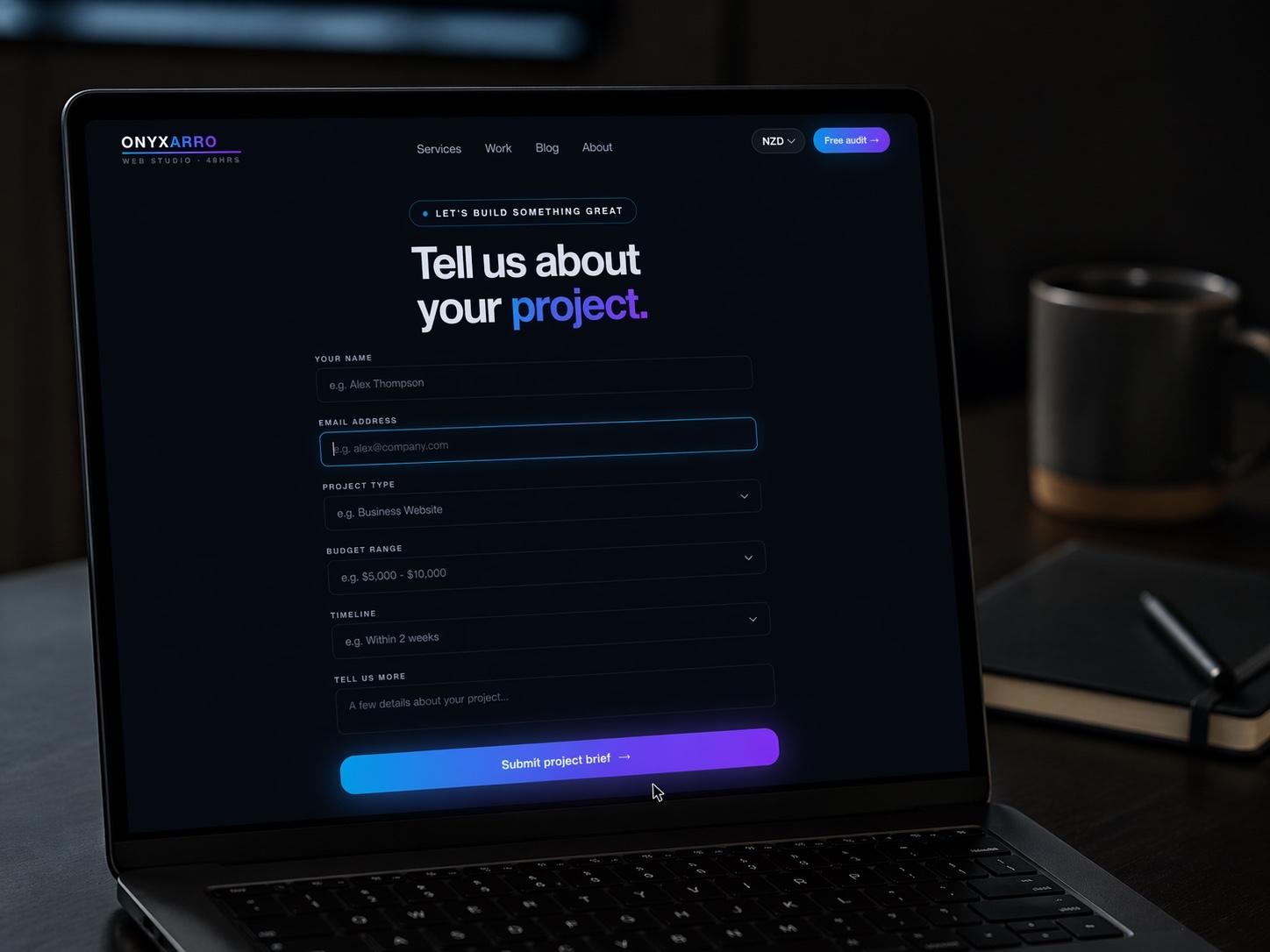
We think about landing pages the same way we think about websites. Their job is to turn the right visitor into an enquiry, and design serves that job rather than the other way round. That means strategy, copy, design, build, tracking, and testing sit inside one scope rather than being sold as surprise extras.
Onyxarro at a glance
- Launch: NZ$5,000 NZD for up to 5 pages. A common fit for a focused site plus a campaign landing page.
- Growth: NZ$8,000 NZD for up to 10 pages, useful when you need separate landing pages per service.
- Studio: from NZ$13,000 NZD for custom scope.
- Included as standard: conversion-focused copy, mobile-first design, form testing, and SEO foundations.
- You own it: your domain, your hosting, your files.
If you only need a single campaign page and already have a solid website, we'll scope that honestly in the audit. If a builder template would do the job, we'll say so. Paying for more than you need is still paying too much.
We're a young studio, so we lead with clear scope and craft rather than a wall of case studies. Our concept demos are labelled as concept work, not client results. The easiest next step is to get a free website audit of the page you're sending traffic to, or compare our website packages and pricing side by side.
The Bottom Line
So, how much does a landing page cost? Typically NZD $500 to $1,500 for a template, $2,500 to $6,000 for a properly scoped conversion page, and more for agencies running ongoing tests. The right number depends on what's riding on it.
If the page is a quick experiment, keep it cheap. If it's about to receive real ad spend, pay for strategy, copy, and tracking, because that's where the money comes back. A landing page should remove doubt, not add more of it in a nicer font.
Not sure which side of that line you're on? Start with a free audit and we'll tell you what to fix first.